Is Patching Your AC Worth It During a Fargo Heatwave?
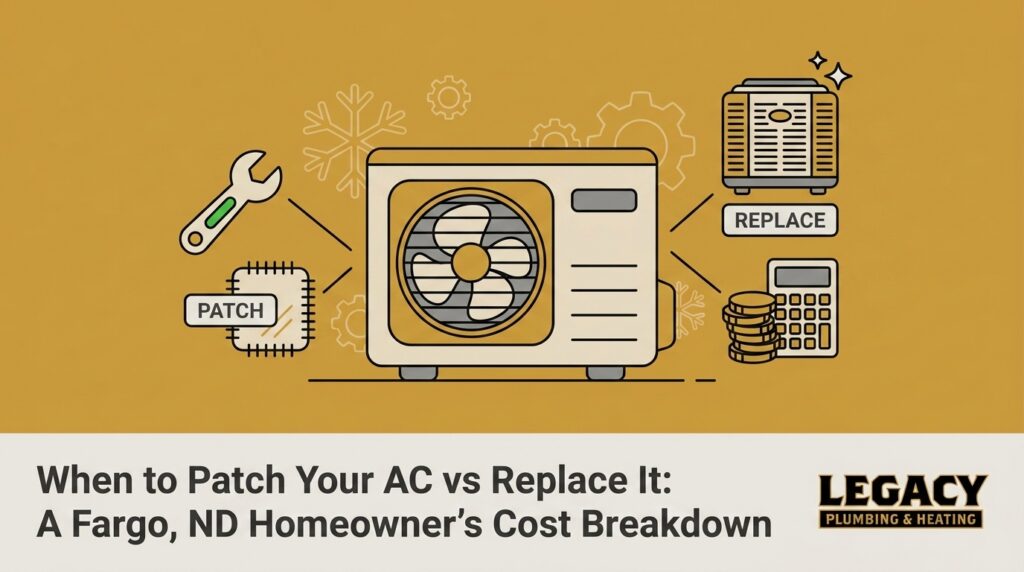
Are you staring at a blank thermostat during a July heatwave, wondering when to patch your AC and when to replace it: a Fargo homeowner’s cost breakdown is exactly what you need to make the right financial call. Losing your cooling system when temperatures peak is incredibly stressful. Your home quickly becomes uncomfortable, and the pressure to make an immediate decision can lead to costly mistakes. You are faced with a frustrating dilemma: do you pay for an emergency patch that might fail again in a few weeks, or do you bite the bullet and invest in a completely new system?
Making this choice requires looking past the immediate panic of a hot house. You need an objective framework to determine if a repair is a sound investment or simply throwing good money after bad. We provide reliable AC repair services to get your system running, but we also want you to understand the long-term math behind your equipment. This guide will give you the tools to evaluate your aging air conditioner, understand how our local climate impacts its lifespan, and confidently decide whether to repair or replace your unit.
How a Humid Fargo Summer Pushes Aging Compressors to the Brink
A humid Fargo summer is notoriously tough on mechanical cooling equipment. To understand why older air conditioners struggle so much in our region, you have to look at the two different types of work your system performs: sensible cooling and latent cooling.
Sensible Cooling vs. Latent Cooling
Sensible cooling is the process of lowering the actual temperature in your home. When the thermostat drops from 78 degrees to 72 degrees, that is sensible cooling in action. Latent cooling, on the other hand, is the process of removing moisture from the air. In a dry climate, an air conditioner mostly handles sensible cooling. But during a humid Fargo summer, your system spends a massive amount of energy pulling heavy, saturated moisture out of your indoor air before it can even begin to lower the temperature effectively.
The Breaking Point for Aging Compressors
When July brings high dew points to the region, your air conditioner is forced to work overtime. The compressor—the heart of your cooling system—has to pump refrigerant continuously to maintain a cold evaporator coil. As warm, humid house air blows over that coil, the moisture condenses into water and drains away.
If your compressor is aging, its internal valves and motors are already worn down. Forcing it to run non-stop to handle heavy latent cooling loads pushes it to the absolute brink. This is exactly why band-aid fixes on older units are highly vulnerable to failure during peak load conditions. You might replace a capacitor or a fan motor, but if the compressor itself is exhausted from years of fighting high humidity, another major breakdown is usually right around the corner. If you are currently deciding between AC repair and replacement, understanding this climate-specific stress is a critical part of the equation.
The Age Multiplier Formula: Calculating Your Tipping Point
When you receive a quote for a major repair, you need a way to measure that cost against the remaining lifespan of the equipment. The Age Multiplier formula provides a concrete, objective decision framework without relying on guesswork.
How the Formula Works
The rule is straightforward: you multiply the age of your air conditioner by the estimated cost of the repair. If the resulting number approaches or exceeds a significant fraction of what a brand-new system would cost, the repair is no longer a wise financial choice. Because equipment costs vary, we focus on the relative multiplier rather than a rigid dollar amount.
If your system is relatively new, even a moderate repair makes mathematical sense. If your system is well over a decade old, even a minor repair starts to look like a poor investment because the unit has already reached the end of its designed lifecycle.
Comparing Your Options
Here is a breakdown of how the age and condition of your system dictate the best path forward when considering a new AC installation versus a patch:
| System Age | Repair Type | Efficiency Status | Recommended Action |
|---|---|---|---|
| 1 to 5 Years | Minor or Major (Often under warranty) | High (Modern SEER standards) | Patch/Repair. The system has plenty of life left and parts are likely covered. |
| 6 to 9 Years | Minor (Capacitor, contactor) | Moderate | Patch/Repair. Fix the minor issue, but start budgeting for future replacement. |
| 10 to 14 Years | Major (Compressor, coil leak, motor) | Low (Declining performance) | Replace. The multiplier is too high. A major repair on a declining unit is a poor investment. |
| 15+ Years | Any repair beyond basic maintenance | Very Low (Obsolete technology) | Replace. Do not sink money into a system that has outlived its expected lifespan. |

The R-22 Refrigerant Factor in Older Systems
If your air conditioner was installed before 2010, there is a very high probability that it uses R-22 refrigerant. This single factor can completely change the math on whether a system is worth repairing.
The EPA Phase-Out
R-22, commonly known by the brand name Freon, is a hydrochlorofluorocarbon (HCFC) that has been phased out by the Environmental Protection Agency due to its ozone-depleting properties. As of 2020, the production and importation of R-22 became illegal in the United States. The only R-22 available today is recovered, recycled, or drawn from dwindling stockpiles.
Why Recharging is Impractical
Air conditioning systems do not consume refrigerant like a car consumes gas. If your older system is low on R-22, it means there is a physical leak in the copper lines or the evaporator coil. Because the supply of R-22 is heavily restricted, the cost to recharge a leaking system has skyrocketed.
Paying to patch a leak and refill an R-22 system is rarely a good idea. The high cost of the refrigerant, combined with the likelihood that an aging coil will simply spring another leak in a different spot, makes it a losing battle. Modern systems use environmentally friendly refrigerants, such as R-410A or the newer R-454B, which offer better heat transfer capabilities and lower long-term maintenance costs.
Energy Efficiency: The Hidden Cost of Holding On
When evaluating a major repair, homeowners often focus entirely on the upfront invoice. However, the hidden cost of holding onto an aging, patched-up air conditioner is the money you lose every month on your utility bill.
Decoding SEER Ratings
Air conditioner efficiency is measured by the Seasonal Energy Efficiency Ratio (SEER). The higher the SEER rating, the more cooling output the system delivers for every watt of electricity it consumes. Over the last decade, federal efficiency standards have increased significantly. A system installed fifteen years ago might have a SEER rating of 10 or 12. Today, the minimum standard is much higher, and high-efficiency variable-speed units can easily reach SEER ratings in the 20s.
The 20% to 50% Rule
According to Department of Energy data, upgrading to a high-efficiency system can reduce your cooling energy consumption by 20% to 50% compared to an older, less efficient model. When you apply those percentages to your summer utility bills, the savings add up quickly.
- Reduced run times: Modern systems cool your home faster and more evenly.
- Better humidity control: Advanced blower motors remove moisture efficiently, allowing you to feel comfortable at a higher thermostat setting.
- Less wasted power: Older components draw more amperage as they degrade, silently driving up your electrical costs.
The compounding operational cost of running a patched, inefficient unit constantly during a humid Fargo summer often offsets whatever money you thought you saved by skipping the replacement.
Emergency Breakdowns vs. Strategic Upgrades
There is a massive difference between replacing your air conditioner on your own terms and being forced to replace it during an emergency breakdown.
The Reality of Emergency Breakdowns
When an aging air conditioner finally suffers a catastrophic failure, it almost always happens on the hottest day of the year. This is when the system is under the most stress. Unfortunately, this is also when HVAC companies are the busiest. If you wait for a total failure, you run headfirst into parts scarcity and scheduling delays. You might find yourself waiting days for a specific compressor or fan motor to ship, leaving your family sweltering in a hot house.
The Strategic Upgrade Advantage
Planning a replacement before the system completely dies gives you total control. You have the time to research different models, evaluate SEER ratings, and schedule the installation at your convenience.
At Legacy Plumbing & Heating, we believe in providing honest, pressure-free evaluations. We act as a neutral, regionally-aware expert to help you weigh the pros and cons of your specific situation. We will never push you into a replacement you do not need, but we will give you the transparent data required to make an independent decision. Whether you need immediate AC service in West Fargo or a consultation for a strategic upgrade, understanding your options beforehand eliminates the stress of a sudden breakdown.
Frequently Asked Questions About AC Repair vs. Replacement
How do I know if my AC is worth repairing?
You can determine if your AC is worth repairing by evaluating the age of the unit, the frequency of recent breakdowns, and the relative cost of the repair. If the system is under ten years old, uses modern refrigerant, and the repair is minor, it is usually worth fixing. However, if you are calling for repairs every single summer, those costs indicate a failing system.
What is the rule of thumb for replacing an air conditioner?
The best rule of thumb is to use the Age Multiplier formula. You multiply the age of the equipment by the estimated cost of the repair. Consider replacement if the unit is over 10 to 15 years old, requires major component fixes like a new compressor, or if the math shows the repair approaches the fractional cost of a new installation.
Is it better to repair or replace a 10-year-old AC?
At 10 years old, the efficiency gains from a new unit often outweigh the temporary benefits of an expensive repair. This is especially true if the system uses obsolete R-22 refrigerant or has a history of poor performance. A new system will offer better warranties, lower utility bills, and vastly improved reliability.
What are the signs a compressor is failing under heavy cooling loads?
Look for hard starting, unusual grinding or clanking noises, and an inability to properly dehumidify the home. You might also notice that the system runs continuously without ever reaching the set temperature on your thermostat. Frequent tripped breakers are another major red flag that the compressor is drawing too much power.
How does humidity impact my AC’s lifespan?
High humidity requires the system to work much harder to remove moisture from the indoor air before it can drop the temperature. This heavy latent cooling load accelerates wear-and-tear on moving parts, especially the compressor and blower motor. Over time, fighting constant high humidity will shorten the overall lifespan of the equipment.
Make a Confident Choice for Your Home’s Cooling
Deciding between a quick patch and a full system replacement doesn’t have to be a guessing game. The right choice always balances your immediate comfort needs with long-term return on investment and energy efficiency. By applying the Age Multiplier formula, factoring in the high cost of older refrigerants, and understanding the strain of a humid Fargo summer, you can clearly see when a repair is no longer worth the risk.
You deserve a clear, objective cost-breakdown framework that tells you exactly when to walk away from a temporary fix. Don’t wait for a total system failure to force your hand. Reach out for a professional, transparent evaluation today, and secure reliable, highly efficient cooling for your home.